
 Office Fit-Out Services
 Office Furniture
 Services
 Shop
Shop About Us
 Contact Us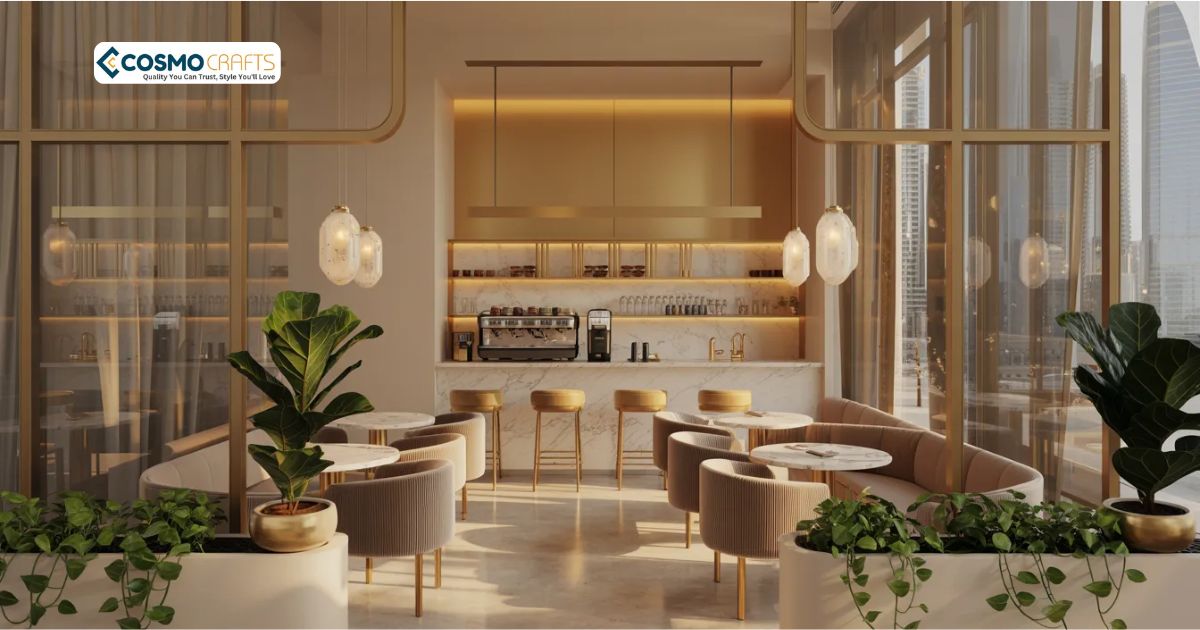
Small Cafe Design Ideas Dubai — Compact Layout Strategies That Work (2026)
In Dubai’s F&B market, bigger is not always better. Some of the most profitable, most talked-about, and most consistently full cafes in the city operate out of spaces under 400 square feet. What they lack in floor area they more than compensate for in design intelligence, spatial efficiency, and customer experience.
Small cafe design is not a compromise. Done correctly, it is a competitive advantage. A compact, well-designed cafe creates intimacy, reduces operational costs, lowers fit-out investment, and — critically in Dubai’s high-rent commercial landscape — allows operators to occupy premium locations that would be unaffordable at larger scales.
But small cafe design is also significantly harder to execute well than a large space. Every decision carries more weight. A poorly placed counter in a 1,000 sq ft cafe is an inconvenience. In a 300 sq ft cafe, it is a disaster. There is no room for error, no space to hide mistakes, and no opportunity to compensate for design failures with sheer square footage.
This guide covers the compact layout strategies, design principles, and practical decisions that make small cafe design succeed in Dubai’s unique and demanding market — and how CosmoCrafts, Dubai’s most experienced cafe fit-out company, delivers them at the highest standard.
The Small Cafe Opportunity in Dubai — Why Compact Works
Before diving into small cafe design principles, it is worth understanding why the compact cafe format is one of the most exciting opportunities in Dubai’s 2026 F&B landscape.
Rent economics favour small footprints. Dubai’s prime commercial locations — JLT, Business Bay, DIFC, Downtown, Marina — command premium rents that make large cafe formats financially challenging for independent operators. A brilliantly designed 250 to 400 sq ft small cafe in a high-footfall corridor can generate comparable revenue to a poorly managed 800 sq ft competitor at significantly lower overhead.
The kiosk and micro-cafe model is surging. Across Dubai’s major developments — mall food courts, tower lobbies, transit nodes, and corporate campus food halls — compact kiosk formats are outperforming larger F&B operators on revenue per square foot. The best of these are not kiosks in the traditional sense — they are architectural objects, designed with the same care and ambition as full-format restaurants.
Delivery dependency reduces the need for dine-in capacity. Dubai’s extraordinary delivery culture — driven by Talabat, Noon Food, and Deliveroo — means a small cafe design that prioritises quality grab-and-go service and delivery kitchen efficiency can build a substantial revenue base without requiring large dine-in capacity.
Intimacy is a luxury. In a city of oversized malls and sprawling F&B venues, a small, beautifully designed cafe that feels personal, curated, and considered is a genuinely differentiated product. Customers seek out intimacy. Small cafe design done well creates exactly that feeling.
The 8 Principles of Brilliant Small Cafe Design
Principle 1 — The Counter Is Everything
In a standard cafe, the counter is the most important single element. In small cafe design, it is the entire spatial concept. Everything — customer flow, staff workflow, visual identity, and revenue generation — radiates from the counter.
The counter in a small cafe design must achieve five things simultaneously: it must be immediately visible and identifiable from the entrance, it must accommodate the full coffee and food preparation workflow without bottlenecks, it must create a visual statement that communicates brand quality, it must define a clear and efficient queue, and it must leave enough customer-facing floor area for the intended dwell experience.
Getting the counter position, dimensions, and design right is the single most important decision in a small cafe design project — and it must be made before any other spatial decision follows.
In Dubai’s small cafe design market in 2026, the counter aesthetic direction is toward honest materials — honed marble or stone surfaces, solid timber or powder-coated metal fascias, integrated shelving that displays product without cluttering the visual field, and counter-level lighting that makes the coffee preparation process visible and compelling.
CosmoCrafts’ cafe interior design Dubai process begins every small cafe design project with counter design — because until the counter is resolved, no other spatial decision can be made with confidence.
Principle 2 — Vertical Space Is Your Most Underused Asset
Floor area is finite in a small cafe design. Vertical space almost never is. The most effective compact cafe layouts in Dubai exploit every metre of wall height — through tall shelving that displays product and creates visual richness without consuming floor area, wall-mounted seating that frees the floor plane entirely, pendant lighting at varying heights that adds spatial complexity, and ceiling treatments that draw the eye upward and make the space feel taller than it is.
Wall-mounted shelving that combines product display, brand storytelling, and acoustic treatment is one of the highest-value investments in small cafe design. A wall of carefully curated coffee equipment, branded merchandise, seasonal ingredients, and design objects tells the brand story, reduces visual clutter at floor level, and creates a backdrop that photographs beautifully.
CosmoCrafts’ wall furnishing services Dubai and cabinet installation Dubai services specialise in exactly this kind of wall-integrated storage and display — custom built to the precise dimensions of the space and finished to the standard that Dubai’s competitive cafe market demands.
Principle 3 — One Strong Design Concept, Executed Perfectly
The temptation in small cafe design is to compensate for limited floor area with maximum visual complexity — multiple materials, competing colours, eclectic furniture, and layered decorative objects. This is almost always a mistake.
The most successful small cafe design projects in Dubai are built around a single, clear design concept executed with complete commitment. One primary material. One dominant colour. One hero piece — whether that is a counter, a feature wall, a pendant light, or a bespoke piece of furniture. Everything else serves that central concept without competing with it.
This principle of disciplined restraint is harder to execute than it sounds — because it requires confidence to edit aggressively and resist the impulse to add. But the result is a space that feels intentional, coherent, and visually compelling from every angle — exactly what small cafe design in Dubai’s saturated market requires.
Principle 4 — Flexible Seating Multiplies Your Revenue Capacity
Fixed seating in a small cafe design is a liability. It locks your revenue capacity to a single configuration and prevents the space from adapting to the different customer patterns that define different times of day — the morning solo commuter, the midday working lunch pair, the afternoon friend group, the evening couple.
The most commercially effective small cafe design seating strategy combines three elements: a small number of fixed anchor pieces — typically a banquette along one wall that creates a defined dine-in zone — with a majority of flexible individual seats and tables that can be combined, separated, or removed as demand requires, and counter-height seating at the window or along a wall that serves solo customers without consuming table capacity.
In a 300 sq ft small cafe design, this approach can accommodate twelve to sixteen customers in multiple different configurations — a number that would be impossible with conventional fixed table-and-chair arrangements.
Furniture selection for small cafe design must prioritise stackability, lightness, and commercial durability. Pieces that look beautiful but cannot be moved easily by a single staff member without damaging the floor are a constant operational problem in compact cafe environments.
Principle 5 — Light Makes Small Spaces Large
Lighting is the most powerful tool available to a small cafe design — capable of making a 250 sq ft space feel intimate and considered rather than small and cramped, if deployed correctly.
The lighting strategy for small cafe design in Dubai follows three rules:
Warm, not bright. Colour temperatures of 2700 to 3000K create warmth and atmosphere. Anything cooler reads as clinical and makes a small space feel institutional rather than inviting.
Layered, not uniform. A single overhead lighting source flattens a small space visually. Layered lighting — ambient ceiling sources, directional accent spotlights, decorative pendants, and backlit surfaces — creates depth and visual complexity that makes the space feel larger and more considered.
Mirror and reflective surfaces amplify light. A well-placed mirror in a small cafe design does not just create the illusion of more space — it doubles the effective visual depth of the room and multiplies the impact of every light source in the space.
CosmoCrafts’ flooring and glass partition services Dubai includes glass partition systems that borrow light between spaces — a particularly effective technique in small cafe design where a glazed partition between the cafe and an adjacent corridor or lobby can dramatically increase the perceived brightness of the interior.
Principle 6 — The Feature Wall Does Double Duty
In a large cafe, the feature wall is a luxury. In small cafe design, it is a necessity — because it is the primary vehicle for brand communication, visual identity, and social media content generation in a space too compact for multiple design statements.
The feature wall in a small cafe design must work harder than in any other context. It must communicate brand values, create a photographic backdrop compelling enough to generate organic social content, add acoustic performance through material texture, and hold its visual interest across hundreds of customer visits.
The most effective small cafe design feature walls in Dubai in 2026 are built from materials with genuine depth and texture — handmade ceramic tiles in brand colours, natural stone with dramatic veining, custom metalwork screens with Arabic geometric patterns, living moss panels, or hand-applied plaster finishes in warm, earthy tones.
What does not work in small cafe design is a painted mural alone — it reads as flat, fades quickly, and lacks the three-dimensional quality that creates genuine visual interest at close range. In a compact space where customers sit within metres of every wall, surface texture matters enormously.
Principle 7 — Flooring Defines the Spatial Logic
In a small cafe design, flooring is not just a surface — it is a spatial planning tool. The right flooring choice can make a compact space feel larger, define zones without physical partitions, guide customer flow without signage, and absorb acoustic energy without visible treatment.
The flooring strategies that work best in small cafe design for Dubai’s market include:
Large-format tiles in light tones — Fewer grout lines and lighter colours expand the perceived floor area significantly. A 600x600mm tile in a warm stone tone makes a 250 sq ft space feel closer to 400 sq ft visually.
Continuous material across counter and floor — Using the same or complementary materials inside and outside the service counter removes the visual boundary between staff and customer zones, creating openness in a compact footprint.
Directional laying patterns — Planks or tiles laid lengthways along the longest dimension of a small cafe design draw the eye deeper into the space and increase the perceived depth of the room.
Microcement or poured resin — Seamless floors with no grout lines create an uninterrupted visual plane that reads as spacious regardless of actual dimensions. Highly effective in compact small cafe design layouts.
CosmoCrafts’ flooring and glass partition services Dubai covers every option — wooden flooring, parquet flooring, vinyl flooring, laminate flooring, hardwood flooring, carpet flooring, and specialist commercial flooring materials — with the technical expertise to advise which solution delivers the best result for each specific small cafe design brief.
Principle 8 — Back-of-House Efficiency Protects Front-of-House Design
The most elegant small cafe design in the world fails commercially if the kitchen and preparation area behind it is inefficient, cramped, or poorly organised. In a compact cafe, the back-of-house footprint is even more ruthlessly contested than the front — and every square centimetre allocated to storage, equipment, and preparation is a square centimetre taken from the customer experience.
The back-of-house principles for small cafe design are straightforward but demand discipline: equipment selection must prioritise multi-functionality over single-purpose performance, storage must be integrated vertically rather than spread horizontally, refrigeration must be under-counter wherever possible to preserve visual openness, and the workflow sequence from preparation through to service must be designed as a single efficient circuit with no crossover or backtracking.
A professional cafe interior design Dubai team like CosmoCrafts designs front-of-house and back-of-house simultaneously — because the two systems are inseparable in small cafe design and a failure in either one undermines the entire operation.
Small Cafe Design — The Dubai-Specific Considerations
small cafe design in the UAE requires a set of market-specific decisions that do not apply in most other cities.
Mall kiosk regulations — Dubai’s major mall operators — Emaar, Majid Al Futtaim, Meraas — have specific design guidelines for kiosk and inline F&B units that must be followed precisely. A professional fit-out contractor familiar with these guidelines prevents costly redesigns during the approval process.
Food Safety requirements — Dubai Municipality’s food safety regulations specify minimum requirements for preparation surfaces, handwashing facilities, refrigeration standards, and waste management — all of which must be accommodated within a small cafe design footprint without compromising the customer experience.
Delivery rider management — In a compact small cafe design, the interface between delivery riders and dine-in customers is a critical planning decision. A poorly managed collection point creates congestion that damages the in-store experience for paying customers. A well-designed compact collection window or designated handover zone solves this elegantly.
Signage and visibility — In Dubai’s competitive retail and F&B corridors, a small cafe design must work hard to be visible. Backlit signage, open frontage that draws the eye, counter visibility from the entrance, and a distinctive brand element visible from twenty metres are all non-negotiable for a compact format competing for attention in a busy corridor.
CosmoCrafts — Dubai’s Small Cafe Design and Fit-Out Specialists
CosmoCrafts has delivered cafe interior design Dubai projects across the full spectrum of scales — from compact kiosk formats to full restaurant fit-outs — and understands the specific demands of small cafe design better than any generalist contractor.
Their commercial fit-out services Dubai cover every element of a small cafe design project — counter fabrication, feature wall installation, premium flooring, glass partition systems, custom cabinetry, tiling and plumbing, and ongoing handyman services Dubai after handover — managed by one team under one contract.
Their turnkey interior solutions Dubai model is built for exactly the kind of compact, complex fit-out that small cafe design demands — where every decision is interconnected and there is no room for the coordination failures that multi-contractor projects produce.
For further reading on related topics, explore our guides to coffee shop design that attracts customers, luxury interior design trends Dubai, how to choose an interior designer Dubai, modern luxury living room UAE ideas, and the top 10 interior fit-out companies in Dubai.
Frequently Asked Questions
How much does a small cafe fit-out cost in Dubai? A small cafe design and fit-out in Dubai typically ranges from AED 80,000 to AED 250,000 depending on size, specification, and location. Compact kiosk formats can be delivered from AED 50,000 for a standard finish, rising to AED 150,000+ for a premium branded kiosk. CosmoCrafts provides free consultations and itemised quotes before any commitment.
What is the minimum size for a viable cafe in Dubai? Dubai Municipality guidelines require a minimum food preparation area for any licensed F&B outlet. In practice, the smallest viable small cafe design formats in Dubai operate from approximately 150 to 200 sq ft for a pure kiosk model, and 250 to 400 sq ft for a cafe with limited dine-in capacity. Below 150 sq ft, food safety compliance becomes extremely challenging.
How do I make a small cafe look bigger in Dubai? The most effective techniques for making a small cafe design feel larger include large-format light-toned flooring with minimal grout lines, warm layered lighting rather than uniform overhead lighting, mirrors and reflective surfaces that multiply perceived depth, glass partitions that borrow light from adjacent spaces, vertical storage and shelving that draws the eye upward, and a single disciplined design concept rather than multiple competing visual elements.
How long does a small cafe fit-out take in Dubai? A compact small cafe design and fit-out of 200 to 400 sq ft typically takes 4 to 8 weeks from design sign-off to handover. Dubai Municipality F&B licensing and fit-out approvals add 2 to 4 weeks and should be factored into the overall launch timeline. CosmoCrafts manages the full permit process as part of their service.
What are the most important design elements for a small cafe in Dubai? In small cafe design, the counter position and design, vertical space utilisation, lighting strategy, feature wall, and flooring selection are the five highest-impact decisions — in that order. Getting these five elements right creates a space that feels considered, professional, and commercially effective regardless of its actual floor area.
Ready to Start Your Project?
If you have a fit-out or renovation project in Dubai and you want it done right — on time, on budget, with zero coordination headaches — CosmoCrafts is the place to start.
Get in touch today for a free consultation and site visit.
📞 +971 55 145 2819 📧 sales@cosmocrafts.ae 🌐 cosmocrafts.ae 📍 Al Rasis Business Center, Al Barsha First, Al Barsha, Dubai
📸 Instagram 📘 Facebook 📌 Pinterest
Quality You Can Trust. Style You’ll Love.

